Cabling certification: what it means and what to require when your network is handed over
What a certifier measures, how it differs from a continuity tester, how to read each outlet's report and which documents to ask for before you sign off on your cabling.
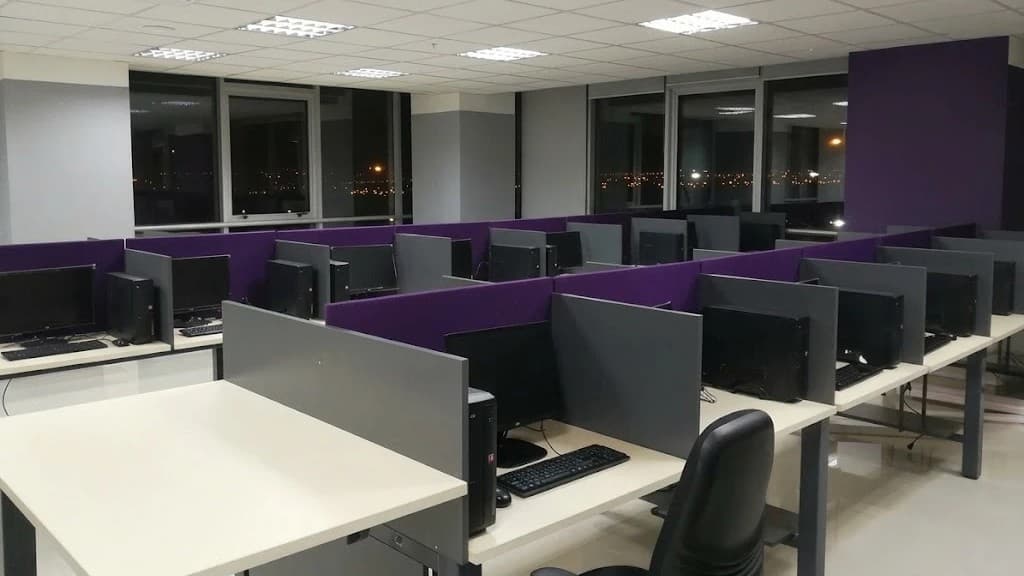
Construction is finished, the installer checked the outlets with a light-up tester and every one lit. The network works. Six months later an access point with a 5 Gbps port arrives, or a PoE-powered camera, and some outlets start failing for no apparent reason. Nobody is quite sure which outlet is which, and when you ask for the manufacturer warranty the awkward question comes up: where is the certification report?
Certifying cabling means measuring every outlet against the standard for its category and putting it in writing. It is the only way to know, on the day you take over the network, that it meets its category and will support the equipment it was designed for.
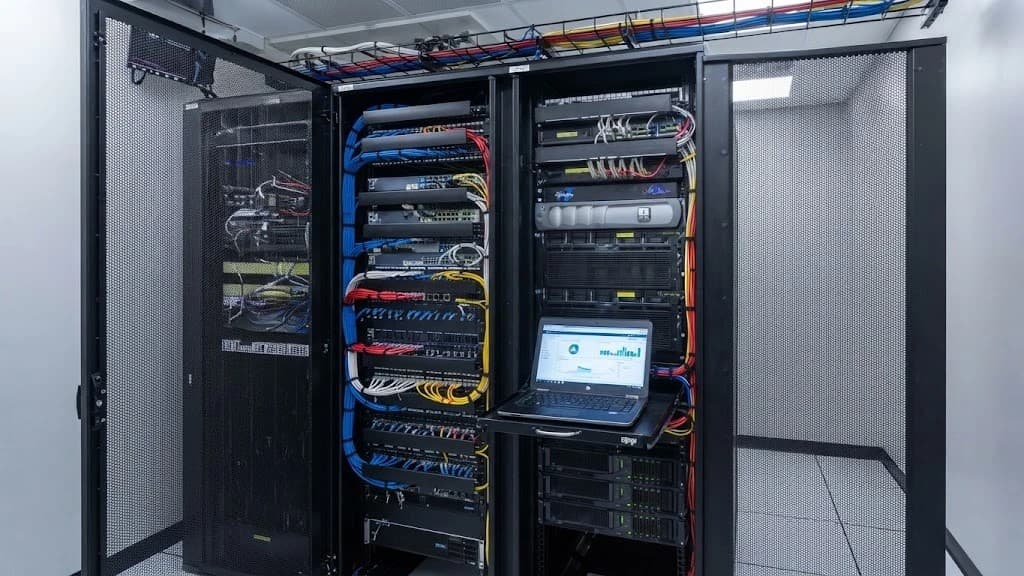
What we find when we review newly delivered networks
Checked only with a continuity tester
It confirms the eight wires are connected, but it does not measure signal quality. Such an outlet can work at 1 Gbps and fail at 10 Gbps or with high-power PoE.
Passes today, fails with the next device
A termination with too much untwisting leaves the outlet with no margin. Current equipment does not notice; the next refresh will.
Nobody knows which outlet is which
Without labels or as-built drawings, every change starts with someone tracing cables with a tone generator, and the network becomes harder to manage.
No report, no warranty
Manufacturers require a certification report for every outlet, produced by a certified installer, before they issue the system warranty.
Testing is not the same as certifying
There are three kinds of instruments for copper cabling, and each one answers a different question. All three are useful, but only one is fit for accepting an installation.
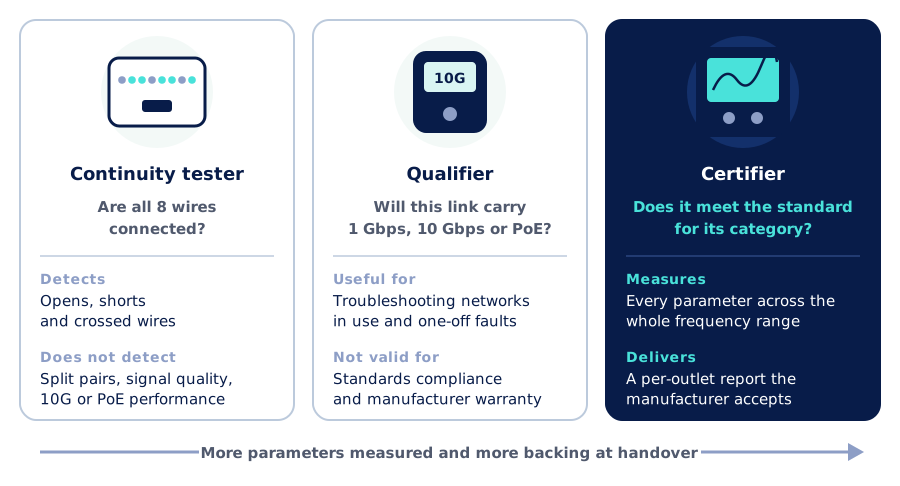
A certifier, such as the TREND Networks units we use on our projects, measures every outlet across the full frequency range of its category and compares it with the limits of the standard (ANSI/TIA-568.2-D or ISO/IEC 11801). The result is a per-outlet report that says whether it passes or fails, and by how much.
What gets measured: permanent link and channel
The standard defines two sections. The permanent link is the fixed cable from the patch panel to the outlet, up to 90 m: it is what the installer builds and what stays inside walls and ceilings. The channel is the full path between the switch and the device, patch cords included, and it cannot exceed 100 m.
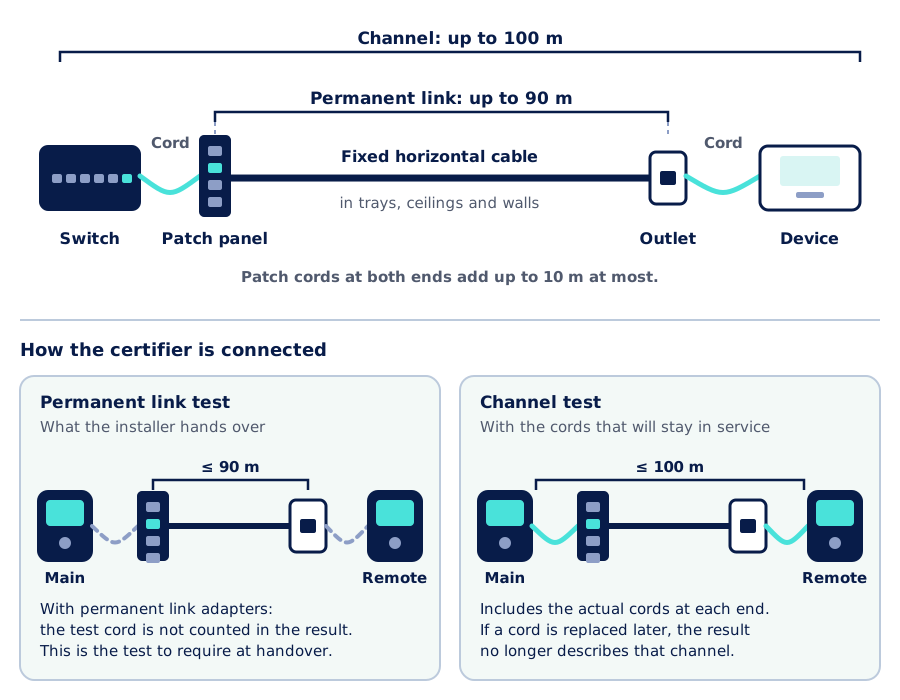
At handover the permanent link is certified, because patch cords change over time and the fixed cable does not. Every outlet is measured against the limits of the installed category: Cat 6, Cat 6A or Cat 8, the latter for short high-speed links inside a data center (25 and 40 Gbps up to 30 m). If you paid for Cat 6A, the report has to say Cat 6A.
How to read a certification report
A report has plenty of graphs, but the first page of each outlet can be read in seconds: result, standard and the margin of each parameter.
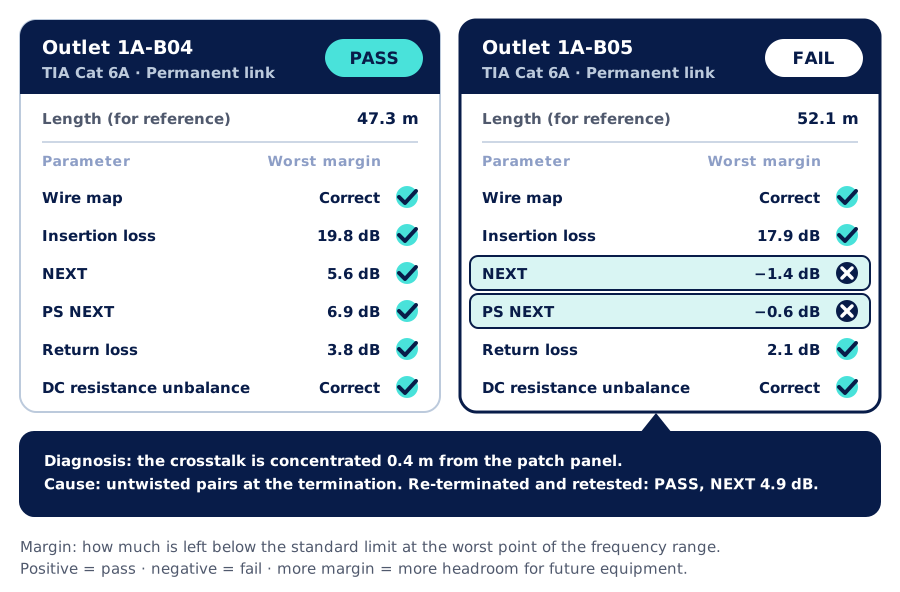
- Wire map. Every wire reaches its position, with no opens, crossed wires or split pairs.
- Length. Reported for reference, it lets you check the design. A permanent link should not exceed 90 m.
- Insertion loss. How much signal is lost along the run. It depends mainly on length and cable quality.
- NEXT and PS NEXT. Crosstalk: how much of one pair's signal leaks into the others. It is the parameter that most often gives away a poor termination.
- Return loss. How much signal bounces back because of impedance changes, such as a connector of another category or a crushed cable.
- Resistance unbalance. Resistance differences between the wires of a pair. It matters for PoE: a high unbalance affects how power is delivered to devices.
The most telling number is the margin: how much headroom there is relative to the limit of the standard. An outlet that passes by 0.5 dB is on the edge; one that passes by 5 dB has headroom for the equipment to come. Some certifiers flag results that fall within the instrument's accuracy range with an asterisk: they are worth a second look.
An example with numbers
Picture an example office with 120 Cat 6A outlets. At certification, 117 pass and 3 fail: two on NEXT, with the fault located less than half a meter from the patch panel, and one on wire map, with one pair reversed at the outlet.
Any tester would have caught the reversed pair. The two outlets with negative NEXT margin, however, would have lit every light and would probably work at 1 Gbps today, yet they are exactly the ones that would fail with a 5 or 10 Gbps access point. They are re-terminated and retested, and the final report shows 120 out of 120 outlets passing.
What you should receive at the end
| Deliverable | What it contains | Why it matters |
|---|---|---|
| Certification report | One result per outlet: standard, date, certifier and margin for each parameter | Proves every outlet complies; the manufacturer requires it for the warranty |
| Original certifier file | The results in the certifier software format, in addition to the PDF | Lets you review any outlet in detail or reissue the report |
| As-built drawings | Actual location and number of every outlet, pathways and racks | Find an outlet or extend the network without guessing |
| Labeling | Outlets, ports, cables and racks with the same identifier, per TIA-606 | The name on the wall matches the one on the panel and in the report |
| Outlet schedule | Identifier, location, patch panel port and result | The everyday tool for whoever manages the network |
| Manufacturer warranty | Manufacturer certificate for the installed system, where the system offers one | Manufacturer backing for components and performance |
Recommended minimum content. The requirements of each project are set in the technical specifications or the contract.
Review the report in five minutes
Count
One report for every installed outlet
Standard
Category paid for, permanent link
Result
All PASS, no pending outlets
Names
Matching the labels on site
Certifier
Model, serial and current calibration
Labeling: every outlet gets a name
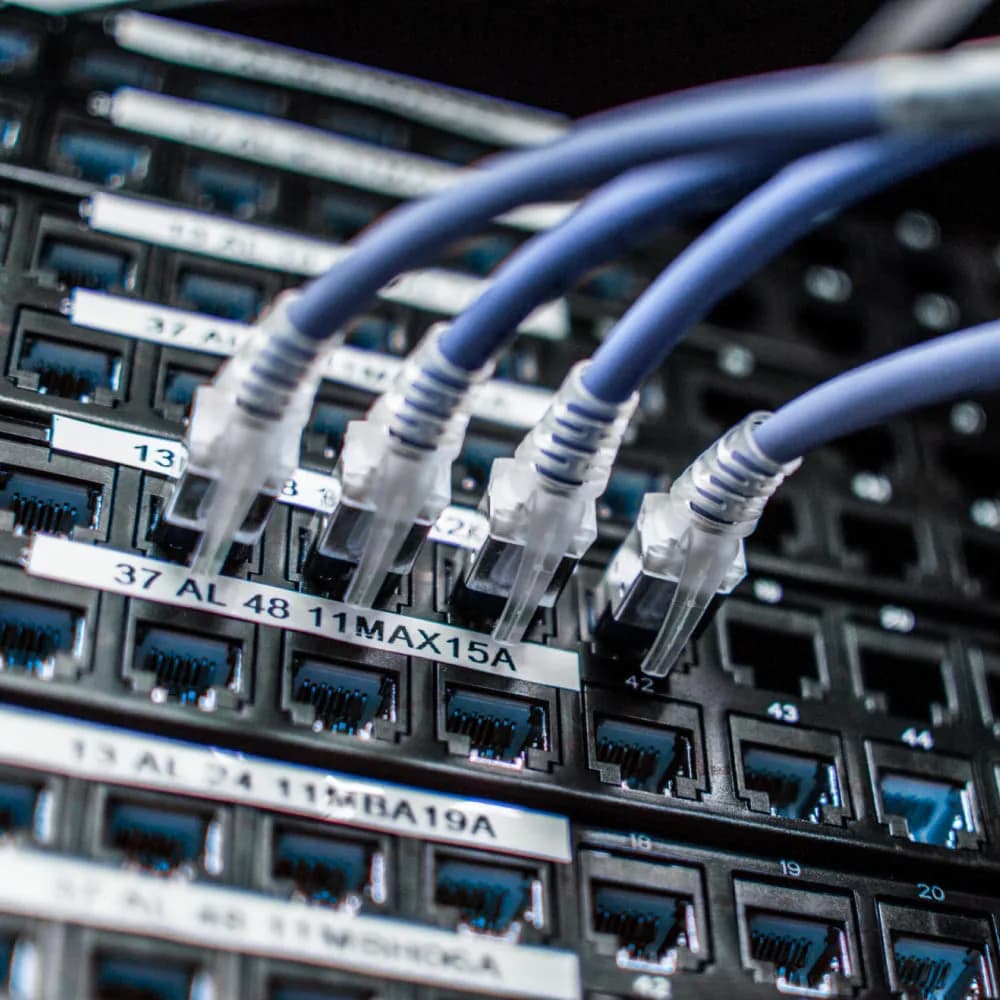
The ANSI/TIA-606 standard defines how to identify each element of the infrastructure. One identifier, for example 1A-B04 (floor 1, room A, patch panel B, port 04), appears on the outlet, on the patch panel port, at both ends of the cable, on the drawings and in the report. When someone reports that their desk has no network, the outlet is found in seconds.
How we do it at Aiscnet
- 1
Assessment and survey
Which devices will connect to each outlet, speeds and PoE, available routes and the condition of what is already installed.
- 2
Design
We choose the category based on how each outlet will be used (Cat 6, Cat 6A or Cat 8), the routes and the length of every link so that none exceeds 90 m (a 30 m channel for Cat 8).
- 3
Phased implementation
Coordinated with your operation, with terminations done to the manufacturer's instructions and labeling from day one.
- 4
Certification of every outlet
With TREND Networks equipment, against the standard for the installed category. Any outlet that fails or sits on the edge is fixed and certified again before handover.
- 5
Documented handover
Per-outlet reports, the original certifier file, as-built drawings, an outlet schedule and the manufacturer warranty where the system offers one.
- 6
Support
We remain available for expansions, changes and troubleshooting.
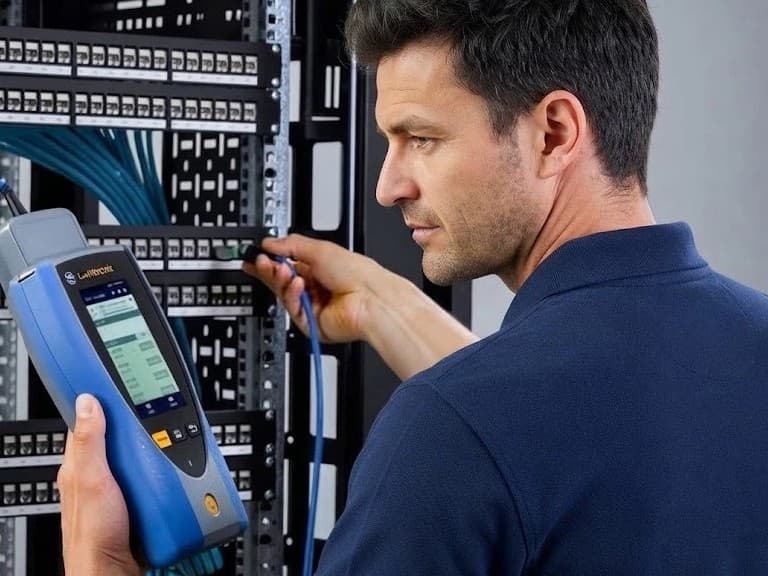
Certified Leviton and TRIMERX installers
As certified installers, we deliver every outlet measured and certified, with the manufacturer warranty where the system offers one. If your network is already installed and has no reports, we can also certify it outlet by outlet and tell you what shape it is in before you connect new equipment.
Further reading
On AISCNET Learning, our technical training platform, you will find free articles and calculators on copper cabling:
- Structured Cabling That Certifies: how a copper network is organized and what the standards say.
- Copper Cable: Which One and Why: categories, shielding and gauge.
- Jacks, Patch Panels & Face Plates: Copper Termination: where most NEXT failures originate.
- TIA-568 channel calculator: whether a run meets 90 m plus 10 m of cords.
- T568A and T568B color code: to terminate every outlet without mistakes.
- Patch panel planner: how many panels and rack units you need.
For technical teams, we run the Copper Structured Cabling course at AISCNET Learning for groups.
And on this blog:
- Category 6A or Category 6 cabling: which category is worth installing.
- Fiber optics for businesses: how a fiber link is certified.
- From a tangled rack to a telecom room that makes sense: the other end of every outlet.
- Site survey and design for tenders: how to write certification into the tender documents.
If you are about to take over an installation or want to know what shape your cabling is in, the initial assessment is free: we review with you what is worth certifying and send you a proposal. Write to us through our contact form or learn more about our network infrastructure service.
- Certificación de cableado
- Cableado estructurado
- TIA-568
- TIA-606
- Enlace permanente
- TREND Networks
- Leviton